How it works
The ARC needle is a passively adjustable-stiffness steerable coaxial needle designed to improve access and accuracy in image-guided percutaneous procedures, without increasing system complexity. It enables controlled trajectory deviations only when needed, while remaining fully usable as a conventional straight needle.
Unlike actively actuated or sensor-based steerable needles, the ARC needle does not force or compensate needle–tissue interaction. Instead, it deliberately leverages the natural interaction between a beveled tip and surrounding tissues to bend in a preferred direction set by the bevel orientation. Local stiffness reduction at the distal end is then controlled by selectively unlocking compliant joints.
Principle of operation
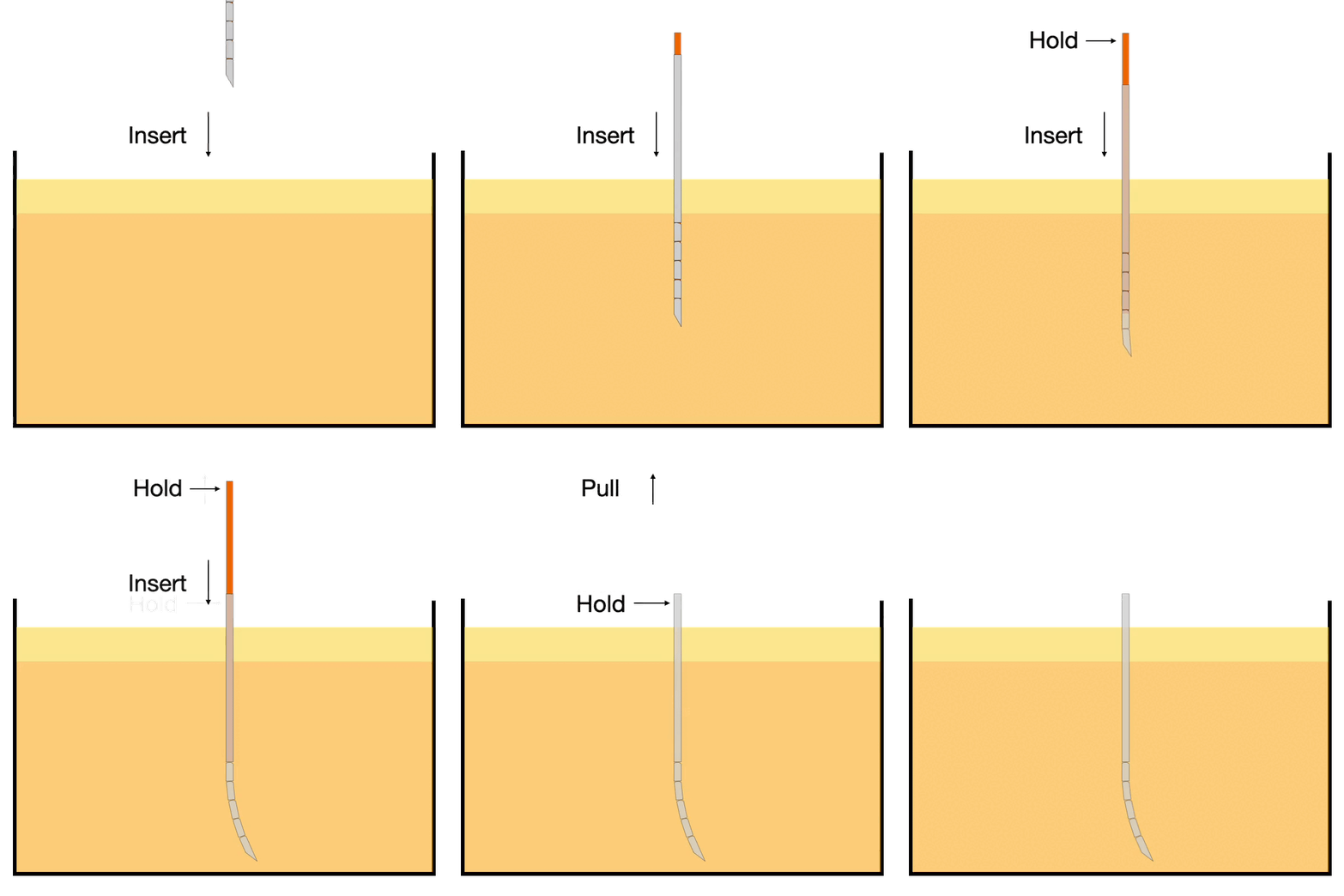
The ARC needle enables the innovative approach single insertion, multiple targets. During insertion, the ARC needle behaves like a conventional coaxial needle. Near the target, the stiffness of the needle tip is decreased to perform the planned trajectory deviations. The direction of deflection is determined by the orientation of the beveled tip.
By avoiding repeated punctures, the ARC needle can reduce procedure time, and limit risks associated with multiple insertions, such as infection or tissue trauma.
In addition, the ability to generate non-linear trajectories opens access to anatomically constrained regions that are inaccessible with conventional straight needles.
Industrial and regulatory relevance
From an industrial perspective, the ARC technology relies on a purely mechanical architecture, with no embedded electronics, no active actuation, and no complex control. This supports robustness, sterilizability, manufacturing scalability, and regulatory compatibility, while keeping integration costs low.
Compatibility and integration
By design, the ARC needle is compatible with standard imaging modalities, including ultrasound, fluoroscopy, computed tomography (CT), and MRI, and is naturally suited for manual use or robotic assistance.
Its degrees of freedom remain simple and decoupled: linear motions for the insertion, and stiffness adjustment, and axial rotation for setting the direction of deflection through bevel orientation. This makes the ARC needle readily integrable into robotic or teleoperated systems, without requiring complex actuation or control schemes.
Targeted applications
The ARC needle is designed for advanced image-guided percutaneous interventions where conventional straight needles impose geometric or anatomical limitations. It is particularly valuable in procedures requiring controlled redirection, multi-target reach, or margin optimization, while maintaining predictable and reproducible behavior.
- Thermal ablation (radiofrequency, microwave, cryoablation), enabling access to multiple lesions, satellite nodules, or circumferential safety margins from a single insertion trajectory—especially in anatomically constrained regions.
- Biopsy procedures, allowing in situ trajectory refinement and sampling of spatially distinct regions without repeated skin punctures, thereby reducing tissue trauma and procedure time.
- Fiducial marker placement, improving deployment accuracy in complex geometries and near critical structures, while minimizing the number of access points.
- Brachytherapy, facilitating access to planned target volumes with controlled deviation, while remaining compatible with standard dosimetric planning workflows.
Advanced and borderline applications
- Targeted drug delivery and intratumoral injections, particularly in heterogeneous, deformable, or poorly accessible soft tissues where spatial precision directly impacts therapeutic distribution.
- Drainage and access procedures, enabling fine trajectory adjustments when navigating near vessels, ducts, or other vulnerable structures.